

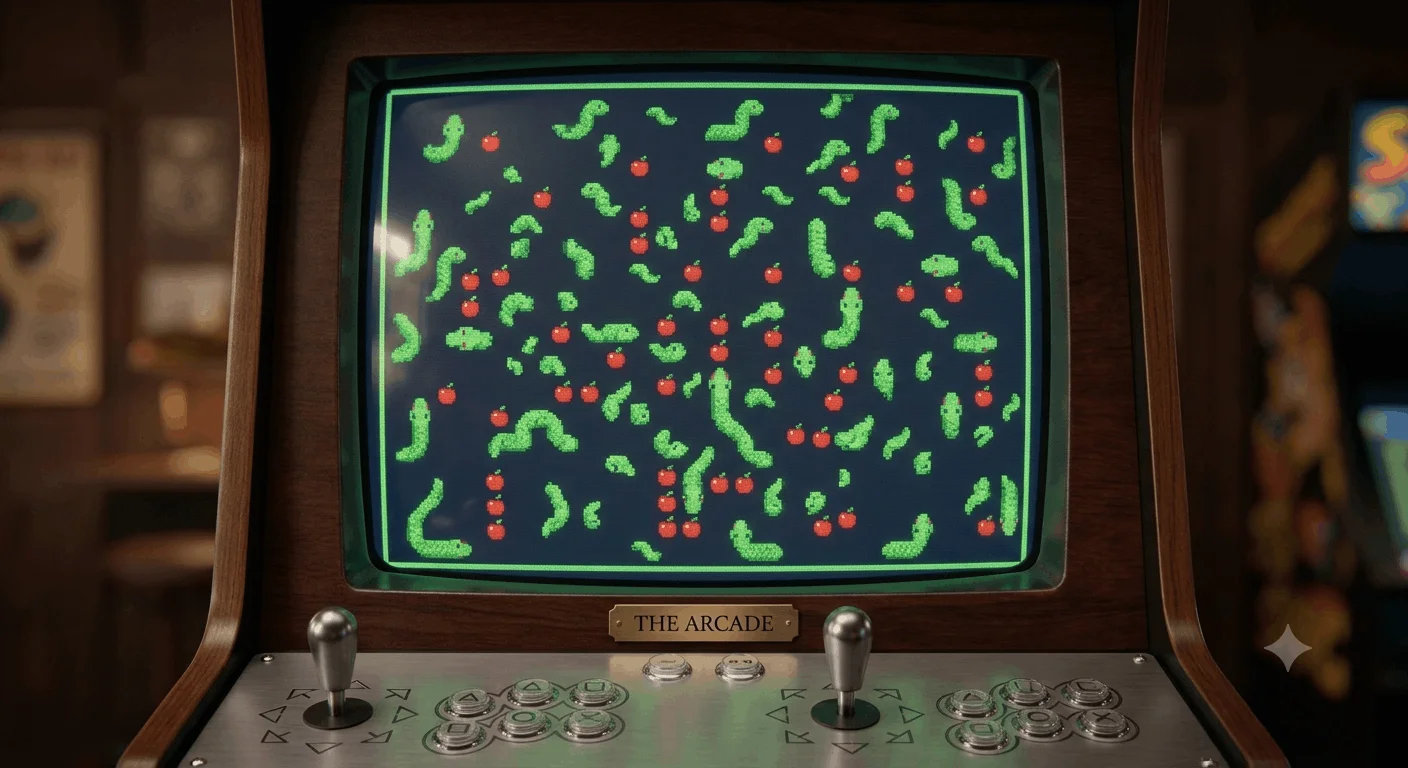
Are you looking for a way to stop crashing your snake every thirty seconds and start racking up scores that actually feel satisfying?
Most people who pick up the snake game think it is just about reflexes. Move fast, eat food, do not crash. But anyone who has tried chasing a high score quickly figures out that pure speed is not what gets you there. The game rewards planning far more than reaction time. That gap between a score of 30 and a score of 300 is almost entirely decision-making, not finger speed.
In this blog, you will learn the real history behind the snake game, how the mechanics actually work, which versions are worth playing, proven tips that high-scoring players actually use and where this classic is heading next.
What Is the Snake Game and Where Did It Come From?
The snake game is older than most people realize and its history is genuinely interesting once you look into it.
The story starts in 1976 with an arcade game called Blockade, made by Gremlin Industries. Two players each controlled a line on screen that kept growing and the goal was to make the other player crash into a wall or your line. That competitive mechanic was the seed that eventually grew into Snake as we know it.
The next big step came in 1982 with a game called Snake Byte on the Apple II. That was actually the first version where the snake ate apples. Before that, the game had no food mechanic at all. Snake Byte added the grow-as-you-eat system that every version since has used as its core loop.
Nokia then took the concept and put it in front of hundreds of millions of people. A Finnish programmer named Taneli Armanto wrote the Nokia version in 1997 for the Nokia 6110. It shipped preloaded on the phone and spread globally as the handset sold across dozens of countries. For a generation of people, that Nokia version was their first video game experience. The simplicity of the concept, combined with the fact that everyone had a Nokia in their pocket, made it genuinely universal.
Google added its own version as a browser Easter egg around 2013 and it is still there. Search for the Snake game in Google right now and a playable version appears at the top of the results.
How Does the Snake Game Actually Work?
Understanding the mechanics helps you play better. Here is what is actually happening behind the simple surface.
The snake moves on a grid. On the classic version, the grid is 20 columns by 15 rows, which gives you 300 cells to work with. Each time the snake eats a food pellet, it grows by one segment. That means by the time you hit 100 points on classic mode, your snake body is covering roughly one-third of the entire playable area.
The game speeds up as your score increases. In classic mode, the snake starts at about six moves per second and accelerates after every five food pellets you eat. By the time you pass 50 points, the snake is moving close to twice as fast as when you started. On fast mode, it launches at 12 moves per second. The Impossible mode starts at around 18 moves per second on a smaller 15 by 10 grid, which gives you far less room.
The reason most players die is not that they reacted too slowly. It is that they turned toward food without thinking about where their tail would be by the time they got there. The tail is always the danger you are not looking at.
What Are the Most Popular Versions of the Snake Game?
The original concept has been remade hundreds of times across different platforms.
- Nokia Snake, which most people over 30 remember as their first encounter with the game and which ran on basic hardware with no color or sound beyond a simple beep
- Google Snake, which appears as a hidden game in Google search results and is one of the most accessible versions since it requires no download or sign-up
- Slither.io, which took the basic snake mechanic and turned it into a massively multiplayer online game where you compete against real players from around the world
- Snake.io, which is a similar multiplayer approach with slightly different mechanics and a bigger focus on speed
- The Original Snake, which is a browser-based version with three difficulty modes, including Classic, Fast and Impossible, plus a global leaderboard where you can compare scores
What Are the Real Benefits of Playing the Snake Game?
Playing the snake game is not just killing time. There are actual mental benefits that research supports.
- Improves spatial awareness because tracking a growing body across a grid while planning several moves ahead requires you to hold a mental map of the entire playing area at once
- Builds working memory since you have to remember where your tail is, where food is and where walls are simultaneously, while the game keeps moving
- Sharpens focus because a single moment of distraction kills your run, which trains sustained attention in a way that is surprisingly effective
- Develops pattern recognition as experienced players stop reacting to each situation individually and start seeing recurring configurations they already know how to handle
- Reduces stress through the flow state that simple repetitive mechanics can produce when you are playing at a comfortable level
Snake Game Tips That Actually Improve Your Score
These come from studying how high-scoring players approach the game and they work across difficulty levels.
Hug the Walls Early
In the first part of any run, keep your snake close to the edges of the grid and leave the center completely open. When the snake is short, you have more room than you need and the walls give you a predictable path. The open center is your emergency route when food appears in an awkward spot. Think of it as savings you do not touch until you need them.
Think Two Moves Ahead
Before every turn, ask yourself one question. If you go this direction, can you still turn again before hitting something? If the answer is no or you are not sure, take the longer, safer path. A route that costs you two extra moves is always better than a shortcut that boxes you in with no exit.
Develop a Pattern Instead of Improvising
The best players do not make up each move as they go. They follow a repeatable path across the grid and only break from it when food forces them to.
The three patterns that work are the perimeter loop, where you travel along all four edges, the zigzag, where you move horizontally across the full grid width, then drop a row and reverse direction, and the tight coil, where you spiral inward then outward. Start with the perimeter loop as a beginner, switch to the zigzag as your snake gets longer and use the tight coil on the Impossible grid.
Let Food Come to You
This is the single habit that separates good players from great ones. When food appears in a dangerous spot between your body and a wall or inside a loop of your tail, do not chase it. Keep following your pattern and wait for the board to clear. The food is not going anywhere. Chasing food into tight corners is the most common cause of death once your score starts getting respectable.
Prepare for Speed Changes
The game speeds up after every five food pellets. That means right after eating your fifth, tenth and fifteenth pellet, the pace noticeably jumps. Do not attempt risky food grabs right when a speed increase is about to hit. Eat the pellet, let yourself adjust to the new pace and then resume normal play. Most speed-related deaths happen in the few seconds right after an increase.
Snake Game Modes and Difficulty Comparison
| Mode | Starting Speed | Grid Size | Cells Available | Best Strategy |
| Classic | 6 moves per second | 20 x 15 | 300 | Perimeter loop then zigzag |
| Fast | 12 moves per second | 20 x 15 | 300 | Zigzag from the start |
| Impossible | 18 moves per second | 15 x 10 | 150 | Tight coil pattern |
| Google Snake | Variable | 17 x 15 | 255 | Perimeter loop |
| Slither.io | Constant | No fixed grid | Unlimited | Coiling opponents |
How Does Slither.io Differ From the Classic Snake Game?
Slither.io took the basic concept and layered competitive multiplayer on top of it, which completely changes how you play.
In the classic snake game, you are only competing against the grid and your own mistakes. In Slither.io, you are competing against real players and the win condition is different. You grow by eating pellets, but you can also kill other snakes by making them crash into your body. When another player dies, their body turns into a massive pile of food that you can absorb to grow rapidly.
The strategy shifts from avoiding your own tail to reading other players and setting traps. Circling smaller players to cut off their escape route becomes a core tactic. That social and competitive element is why Slither.io became a viral hit in 2016 and still has millions of daily players.
What Does the Future of the Snake Game Look Like?
A game this simple and this old should have faded by now and yet it keeps coming back in new forms.
A few things are keeping it relevant and growing:
- Browser gaming revival, where players who want something quick and zero commitment keep turning to classic games that load instantly without sign-ups or downloads
- Mobile casual gaming growth continues to drive demand for short-session games that are easy to pick up and put down
- AI and multiplayer evolution with new versions exploring what happens when snake mechanics meet machine learning opponents or large-scale real-time multiplayer arenas
- Competitive communities are growing around leaderboard-based versions, where players chase top scores with genuine dedication
- Nostalgia cycles bring the Nokia generation back to the game every few years, while new players discover it for the first time through Google’s hidden Easter egg
The snake game has survived arcades, feature phones, smartphones and browser gaming by being genuinely replayable at any skill level. That core loop of eating, growing and avoiding yourself never stops being satisfying when you are playing well.
Wrapping It Up
The snake game is one of those rare things that has been around for nearly fifty years and still holds up because the mechanics are perfect in its simplicity. Start with the wall-hugging approach, develop a consistent pattern, learn to let food come to you instead of chasing it and prepare for speed changes before they hit. Apply those ideas and your scores will improve faster than you expect. Open up a browser version, set a personal best target and see how long it takes to hit it.
Frequently Asked Questions
What is the snake game?
It is a classic video game where you control a growing line that must eat food without crashing into walls or its own body. It originated from Blockade in 1976 and became famous through Nokia phones in 1997.
How do I play the Google snake game?
Search for snake game in Google and a playable version appears directly in the search results. Use arrow keys on desktop or swipe on mobile. No downloads or accounts needed.
What is the best strategy to score high in the snake game?
Hug the walls early, develop a zigzag pattern as your snake grows, never chase food into tight corners and prepare for the speed increases that happen every five food pellets.
What is the difference between the Snake game and Slither.io?
Classic snake is a solo game against the grid. Slither.io adds real-time multiplayer where you compete against other players, can absorb their bodies when they die and need to set traps to grow fast.
Why does the snake game get harder as you score more?
The game speeds up after every five food pellets and your snake’s body takes up more of the grid as it grows. Both factors reduce your room to maneuver and make each decision more critical than the last.


